
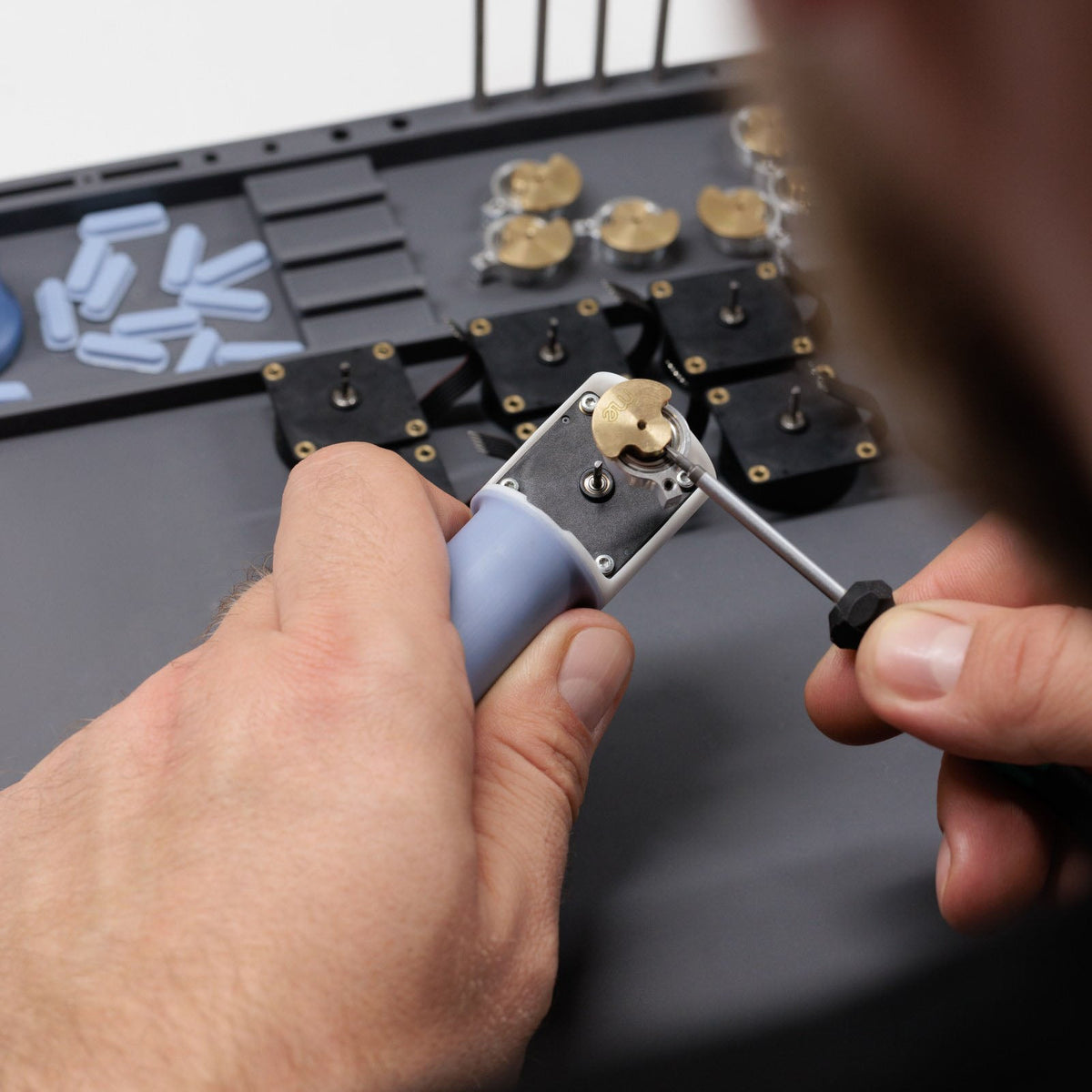
A PMU machine may still switch on, display the correct frequency and move the needle, yet no longer perform as it did before.
The change often begins subtly: the sound becomes more metallic, you feel a slight vibration in your hand, the machine responds differently to a cartridge, or it seems less smooth at a low frequency. Because performance deteriorates gradually, the artist gets used to the new behaviour and starts compensating with their hand.
This is the point at which a technical problem can begin to change your technique.
Not every unusual sound means a fault, and not every change calls for a repair. Cartridges differ in membrane resistance, guide friction and the mass of their moving components. A battery with a low charge can also affect how the machine behaves. A proper assessment therefore relies on comparing the machine under controlled conditions, rather than guesswork.
A PMU machine is an electromechanical system
Inside the machine, the motor's rotary motion is converted into the needle's reciprocating motion. The components involved include the drive mechanism, bearings, drive pin, guides, cartridge, electronics and control software.
A brushless motor reduces wear associated with brushes and the commutator, but it does not make the entire machine indestructible. Microdrive manufacturer FAULHABER explains that the service life of brushless motors is generally limited primarily by ball bearing wear, while the lifespan of the complete system is affected by factors including load, operating conditions and duty cycle.
In practice, this means something straightforward: professional equipment can be durable and serviceable, yet it still completes tens of thousands of cycles during a single treatment. Mechanical parts are working, surfaces are interacting, and an impact or a fall can alter their alignment without leaving a visible mark on the housing.
1. The machine's sound has changed noticeably
Every machine has its own acoustic characteristics. The fact that one machine sounds different from another does not in itself indicate a fault. What matters is a change from the previous behaviour of the same unit under the same conditions.
Signs that may warrant investigation include:
- a new metallic tone,
- repeated knocking or rattling,
- a sound that changes in time with the operating cycle,
- a clear difference between running without a cartridge and with a suitable cartridge known to work correctly,
- a sudden increase in noise at the same frequency.
Sound is affected by speed, load, the way the motor is mounted and the bearing arrangement. A single test with one cartridge is therefore not enough. First, fit a new cartridge from a batch whose behaviour you know. If the noise persists, have the machine assessed.
2. Vibration is stronger than before
A certain level of vibration is natural in a machine that moves cyclically. It is a change that becomes concerning: vibration that was not there before, is increasing, or becomes noticeably stronger within a particular frequency range.
Possible causes include a worn guide component, mechanical play, an incorrectly seated drive component, damage after a fall, or an unusually resistant cartridge. The source cannot be reliably identified without disassembly.
In mechanical engineering, changes in vibration levels are one of the parameters used to monitor the condition of rotating systems. The ISO 20816 series does not provide standards for handheld PMU machines, and its numerical limits must not be applied to our equipment. It does, however, support a general diagnostic principle: a significant change in vibration compared with normal operation needs to be explained.
3. The machine runs unevenly at a familiar setting
Artists are most likely to notice a change at settings they use regularly. If the machine periodically speeds up, slows down, pulses or seems to cut out at the same setting, first distinguish a machine problem from a cartridge problem.
Make three brief comparisons:
- Fit a freshly charged battery in good working order.
- Use a new cartridge of a type you already know.
- Check several frequencies without skin contact, then on latex practice skin.
If uneven operation occurs with only one cartridge, that cartridge is the likely source. If it recurs with several cartridges and batteries known to work correctly, the machine needs a technical assessment.
4. The machine stalls or noticeably loses performance under load
A cartridge adds membrane resistance, guide friction and the mass of moving components to the system. A properly functioning machine should operate within the load range specified by its manufacturer, but not every cartridge places the same load on it.
If the machine begins to stall, slows noticeably, or cannot start smoothly with a correctly fitted cartridge, do not automatically increase the frequency or press the machine harder against the skin. Change the cartridge first. If the symptom recurs, stop working and contact the service team.
Compensating for a fault through the settings may temporarily conceal the symptom, but it does not remove the cause.
5. Needle movement is no longer aligned, or play has developed
The needle should move along the axis of the cartridge guide. Visible sideways movement may originate in the cartridge itself, its guide or an imprecise fit. If it occurs with several correctly functioning cartridges, part of the drive mechanism or the grip may also be responsible.
Do not try to straighten, push into place or adjust parts of the mechanism yourself. A precision assembly operates within specified tolerances, and an adjustment made by eye can increase friction or move the problem elsewhere.
6. The housing heats up differently from usual
The motor, electronics and battery generate heat during operation. A slight, stable temperature change does not necessarily mean a fault. An abnormal situation is one in which the machine suddenly becomes noticeably warmer than during previous sessions of similar length at similar settings.
A rise in temperature may accompany increased friction, abnormal loading, or a problem with the battery or electronics. If the housing becomes hot, there is an overheating smell or smoke, or the battery becomes deformed, switch the machine off immediately. Remove the battery only if it is safe to do so, and do not switch the equipment on again before it has been assessed by the service team.
7. The problem began after a fall or a hard impact
The absence of a dent does not rule out damage. Impact energy can travel through the housing to the bearings, shaft, eccentric mechanism, electrical connections or guide components.
After a fall, look for:
- a change in sound,
- increased vibration,
- runout or sideways movement,
- difficulty adjusting needle protrusion,
- an unstable power supply,
- damage to the thread or grip.
If the machine has fallen from working height, a technical inspection is justified even if it still switches on. Continuing to work on a client should not be a test of the equipment's condition.
8. Liquid may have entered the machine
Pigment, disinfectant or another liquid can enter the housing through buttons, gaps, a port or a thread. Symptoms do not always appear immediately. Over time, contamination can affect contacts, electronics and moving parts.
Do not switch the machine on “to see if it works”, and do not dry it with hot air. Remove the power source if the manufacturer has provided for this and it is safe, then contact the service team. Information about the type of liquid and where contact occurred will help with the assessment.
Cleaning, inspection, repair and upgrades are different things
These terms are often used interchangeably, although they describe different actions.
| Action | Purpose |
|---|---|
| External cleaning | Removing contamination from accessible surfaces in accordance with the manufacturer's instructions |
| Technical inspection | Assessing the condition of the mechanics, electronics, drive system and components subject to wear |
| Repair | Resolving a specific fault and restoring correct operation |
| Upgrade | Introducing a newer technical solution or feature, if the manufacturer offers this option |
An upgrade does not replace the diagnosis of a damaged motor, bearing or component affected by a fall. Likewise, cleaning the housing is not an inspection of the machine's interior.
Should a PMU machine receive preventive servicing?
There is no single correct interval for every machine and every artist. Wear depends on design, operating hours, frequency, cartridge loading, transport, falls, contamination and storage conditions.
Manufacturers of professional rotary machines publish model-specific maintenance procedures, instructions and service processes. This does not mean that one interval applies to every PMU machine. The appropriate schedule should follow the manufacturer's instructions, the intensity of use and the history of the individual unit.
A preventive inspection is especially valuable when the machine is your main working tool, is used for many treatments each week, or has experienced a fall, difficult transport conditions or contact with liquid.
Basic checks before contacting the service team
Before contacting technical support, prepare:
- the machine's serial number,
- a brief description of the symptom and when it occurs,
- information about any fall or contact with liquid,
- the frequency and configuration in use when the problem occurs,
- the cartridge type,
- the result of a test with another new cartridge and another battery in good working order,
- a short recording of the machine's sound or behaviour.
Do not dismantle the body, lubricate the mechanism with an arbitrary product, or try to eliminate mechanical play yourself. Official rotary machine maintenance guidance also states a clear rule: lubricate only when and as specified by the manufacturer.
Which symptoms mean you must stop immediately?
Do not use the machine on a client until it has been assessed if any of the following occurs:
- an overheating smell, smoke or an abnormally hot housing,
- a damaged, deformed or excessively hot battery,
- liquid inside the body,
- sudden, strong vibration,
- visible needle runout with several cartridges known to work correctly,
- the drive mechanism stalling,
- damage to the housing, thread or grip after a fall.
A second machine in good working order is not a luxury in a salon. It safeguards continuity of work and helps prevent the decision to finish a treatment using equipment whose condition is in doubt.
FAQ
Does louder operation always mean the motor is damaged?
No. Sound can change because of the cartridge, its membrane, guide friction, frequency or the way components are fitted. However, if the change occurs with several cartridges known to work correctly and remains different from the same machine's previous operation, a diagnostic assessment is needed.
Can I keep working if the machine only vibrates slightly?
The natural level of vibration depends on the design. New or increasing vibration is the concern. If you feel a clear change, do not judge whether it is safe to continue solely by the fact that the machine still switches on.
Can changing the cartridge solve the problem?
Yes, if the source is a faulty or unusually resistant cartridge. That is why a new cartridge of a familiar type should be the first part of a comparison test.
Does a machine with a brushless motor need no servicing?
A brushless motor has no brushes to wear out, but the machine still contains bearings, mechanical parts, guides, electronics and connections. “Brushless” does not mean “without components subject to wear”.
Is testing the machine on latex enough after a fall?
A test on latex practice skin may reveal an obvious problem, but it does not confirm the condition of the bearings, alignment, connections or electronics. After a hard impact, a technical inspection is the appropriate approach.
Is upgrading a machine the same as repairing it?
No. An upgrade introduces newer solutions offered by the manufacturer. A repair resolves a fault. The machine should be assessed before an upgrade, because a faulty component may require separate replacement.
Conclusions
The condition of a PMU machine is not simply a matter of working or not working. Equipment does not have to stop completely for its behaviour to begin departing from normal.
The most important reference point is change: a new sound, more vibration, a different temperature, uneven operation or a weaker response under load. The first step should be a controlled test with a new battery and a familiar cartridge. If the symptom recurs, the answer is a diagnostic assessment, rather than greater pressure or random setting changes.
Engineering before marketing also means responsibility after purchase: a machine should be well designed and capable of being inspected, repaired and maintained with an informed approach throughout its working life.
If your ME™ machine has started to behave differently, do not try to compensate with your hand. Describe the symptom and contact our technical team — the service team will help distinguish a cartridge or battery problem from an issue with the machine itself.

Leave a comment
All comments are moderated before being published.
This site is protected by hCaptcha and the hCaptcha Privacy Policy and Terms of Service apply.